
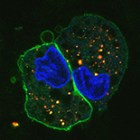
 Researchers have successfully incorporated colloidal nanoplatelets, a disc-like variation on spherical quantum dots, in a biological system. The new “lipoprotein nanoplatelets” were found to be rapidly internalized into living cells while retaining their fluorescence, making them uniquely valuable in live-cell imaging and labelling. Read more at Materials 360 Online…
 Researchers from the University of Cambridge have demonstrated a lithium-air cell that is over 90% efficient.
 NASA’s Dawn mission to Ceres has provided an unexpected picture of asteroid formation.
 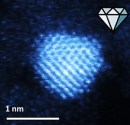 Nanodiamonds, or pure diamonds with a length scale less than a micrometer, are a materials scientist’s best friend in areas such as imaging, spintronics, and quantum computing. Now, researchers have overcome key challenges and developed a straightforward way of producing extremely small, stable, and pure nanodiamonds.
 Assessing the role played by additive manufacturing in aircraft production.
 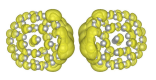 Understanding and manipulating plasmons is important for their potential use in photovoltaics, solar cell water splitting, and sunlight-induced fuel production from CO2. Now, for the first time, the interplay between the plasmon mode and the single particle excitation within a small metal cluster has been simulated directly.
 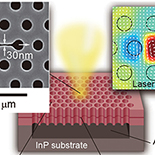 Move over, ELISA. While the Enzyme-Linked ImmunoSorbent Assay has long been one of the most popular ways of detecting and quantifying the presence of antibodies or antigens in solution, nanolasers may be poised to share the spotlight on the biosensor stage.
  A cruise to study landslide potential along an earthquake-prone fault found a surprising methane plume.
 Outlets
- APS Physics (240)
- Berkeley Lab (38)
- Cleantech Concepts (5)
- Encyclopedia of Puget Sound (1)
- Eos (1)
- Europa Science (14)
- IEEE Spectrum (14)
- MRS Bulletin (19)
- Nature (1)
- New Scientist (1)
- Old News (7)
- Pacific Northwest National Lab (8)
- Physics Today (154)
- Physics World (2)
- Science Magazine (16)
- Science News (5)
- Scientific American (30)
- SPIE News (4)
- SPIE Professional (3)
- Tech & Content Writing (5)
- The Scientist (4)
- Travel Writing (4)
- Uncategorized (7)
Topics
- Acoustics
- APS Physics
- Astronomy
- Astrophysics
- Atmospheric Sciences
- Atomic and Molecular Physics
- Batteries
- Berkeley Lab
- Biochemistry
- biology
- Biophysics
- Chemistry
- Climate Change
- Condensed Matter Physics
- Conferences
- Down to Earth
- Earth Sciences
- Ecology
- Electronics
- Energy
- Environment
- Europa Science
- Fluid Dynamics
- Geology
- Geophysics
- IEEE Spectrum
- Lasers
- Machine Learning
- Magnetism
- Materials Sciences
- Medical
- Metamaterials
- Meteorology
- MRS Bulletin
- Nanoscience
- Nuclear Physics
- Oceanography
- Optics
- Photonics
- Physics
- Physics Today
- Plasma physics
- Policy
- Quantum Mechanics
- Quantum Physics
- Scientific American
- Semiconductors
- Soft matter
- Spectroscopy
- Volcanology
 Rachel Berkowitz