
 Collisions between fragments may lead to size segregation of rock piles during asteroid formation. Read more at Physics Today…
 Researchers propose an inexpensive material design that appears able to store and deliver bulk hydrogen at an unprecedented rate. Read more in
 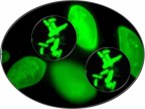 The speed with which microbes in a simplified ecosystem absorb the nanomaterials is raising concerns about the effect on organisms higher in the food chain.
  New thin-film material automatically changes conductivity and helps to harness and repurpose waste heat. Read more in
  The propagation of microwaves offers an effective, low-cost means of detecting polluted air.
  The new fibre delivery options and scanning solutions for ultrafast (and non-ultrafast!) lasers. Read more in
 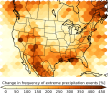 A high-resolution climate model predicts an almost across-the-board increase in extreme precipitation events throughout North America.
  Research at DOE Environmental Molecular Sciences Laboratory featured in Science, Nature and PNAS journals. Read more in print and
  Seismic imaging reveals a cold mantle beneath the volcano and suggests that magma migrates from the east. Read more in
 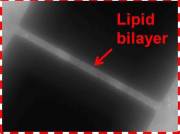 If you want to know how a living cell exchanges information with its surroundings, you have to understand how materials pass through the cell wall. Now, researchers have synthesized lipid bilayers on a flexible, conductive substrate that allows signals to transduce the model membrane. Read more in
 Outlets
- APS Physics (240)
- Berkeley Lab (38)
- Cleantech Concepts (5)
- Encyclopedia of Puget Sound (1)
- Eos (1)
- Europa Science (14)
- IEEE Spectrum (14)
- MRS Bulletin (19)
- Nature (1)
- New Scientist (1)
- Old News (7)
- Pacific Northwest National Lab (8)
- Physics Today (154)
- Physics World (2)
- Science Magazine (16)
- Science News (5)
- Scientific American (30)
- SPIE News (4)
- SPIE Professional (3)
- Tech & Content Writing (5)
- The Scientist (4)
- Travel Writing (4)
- Uncategorized (7)
Topics
- Acoustics
- APS Physics
- Astronomy
- Astrophysics
- Atmospheric Sciences
- Atomic and Molecular Physics
- Batteries
- Berkeley Lab
- Biochemistry
- biology
- Biophysics
- Chemistry
- Climate Change
- Condensed Matter Physics
- Conferences
- Down to Earth
- Earth Sciences
- Ecology
- Electronics
- Energy
- Environment
- Europa Science
- Fluid Dynamics
- Geology
- Geophysics
- IEEE Spectrum
- Lasers
- Machine Learning
- Magnetism
- Materials Sciences
- Medical
- Metamaterials
- Meteorology
- MRS Bulletin
- Nanoscience
- Nuclear Physics
- Oceanography
- Optics
- Photonics
- Physics
- Physics Today
- Plasma physics
- Policy
- Quantum Mechanics
- Quantum Physics
- Scientific American
- Semiconductors
- Soft matter
- Spectroscopy
- Volcanology
 Rachel Berkowitz